I recently sold a small single-family rental that had been part of my hands-on buy-and-hold strategy for several years. I loved the tangible feel of owning a house — the ability to inspect it, make cosmetic improvements, and directly influence cash flow. But I also ran the numbers and recognized the administrative burden, concentrated risk, and illiquidity that come with a single property. That led me to experiment with fractional real estate platforms such as Fundrise and CrowdStreet as possible replacements. Below I share how I approached the switch, what trade-offs I encountered around taxes, liquidity and expected returns, and practical steps you can use if you’re considering the same move.
Why consider fractional real estate as a replacement?
Fractional real estate platforms let you own slices of commercial or diversified residential real estate (or funds that own them) without the day-to-day landlord tasks. For an investor coming out of a single-family rental, the main attractions are:
Diversification: I can spread capital across multiple properties, markets, and property types rather than being concentrated in one neighborhood.Lower operational overhead: No tenant calls at 2 a.m., no repairs coordination, no vacancy advertising.Access to institutional deals: Platforms like CrowdStreet often offer opportunities in larger commercial developments that were once available only to institutions.Simpler scaling: It's easier to redeploy proceeds from a sale into multiple fractional positions than to purchase several single-family homes.But those benefits come with trade-offs — primarily in taxes, liquidity timing, and how returns are realized.
Tax considerations: what changes when you move off-market ownership?
Taxes are one of the first things I scrutinized. Owning a rental property directly gives you certain tax mechanics that fractional investments change significantly.
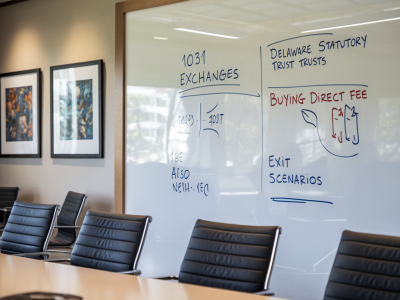
Depreciation and active losses: With a directly owned single-family rental, you typically claim depreciation on the structure (not land), which can shelter rental income from taxes and create passive losses. Fractional platforms often pass-through depreciation via K-1s or Form 1099-NEC/1099-MISC depending on structure, but the specifics vary. Crowdfunded deals structured as LLCs commonly issue K-1s that include depreciation, whereas REIT-style platforms (like some Fundrise offerings) report dividends that may be classified as ordinary, qualified, or return of capital.1031 exchange limitations: If you used a 1031 exchange to defer capital gains after selling a property, note that proceeds must be reinvested in "like-kind" real estate that you directly own. Fractional shares and many platform-based investments typically don't qualify for 1031 treatment because you're buying securities rather than real estate title interests. That was a deciding factor for me: I realized I’d either pay taxes on the sale or need to find another direct property to preserve 1031 tax deferral.Capital gains timing and nature: Direct property sales usually generate long-term capital gains upon sale (if held >1 year), which are taxed at preferential rates. Fractional investments can produce a mix: dividends or interest-like income taxed at ordinary rates, taxable capital gains only when positions are liquidated, and depreciation recapture if K-1s are involved. When I reallocated proceeds, I modelled after-tax returns under several scenarios to ensure I wasn't eroding expected yields through higher ordinary income taxes.Complexity and accounting: Receiving K-1s can complicate your tax preparation; some platforms issue them late in the season. REIT-style distributions may be reported on 1099s but require allocation across ordinary income, qualified dividends, and return of capital. I consulted a tax advisor to anticipate year-end paperwork and estimated tax payments.Liquidity trade-offs: how quickly can you access your money?
Another major difference is liquidity. My single-family rental could be sold, but that process takes months, transaction costs are high, and timing is uncertain. Fractional platforms fall on a spectrum:
Closed-end private deals (CrowdStreet-type): These are typically long-term, illiquid investments aligned with the hold period of the sponsor (often 5–10 years). Secondary markets may exist in limited form, but pricing can be opaque. I treated these as multi-year commitments and allocated only a portion of my proceeds accordingly.Interval funds and eREITs (Fundrise-style): Fundrise offers eREITs and eFunds that provide more frequent windows for redemptions (quarterly or semi-annual) but with limits and gates. They’re more liquid than closed private deals but far less so than listed REITs or stocks. If liquidity is a priority, these vehicles are a better fit; I kept an emergency cash buffer to avoid forced sales during redemption periods.Public REITs and listed alternatives: If you want near-instant liquidity and still exposure to real estate, publicly-traded REITs and listed funds are the most liquid. However, they trade like stocks and can be more sensitive to macro equity market swings than private real estate cash flows.In practice I built a small liquidity ladder — some capital into more liquid eREITs, some into private deals for higher expected yields, and some held back as cash or short-term securities.
Return expectations and risk-adjusted trade-offs
Expected returns are where the rubber meets the road. A single-family rental’s returns are a blend of rental yield, appreciation, tax benefits (depreciation), and leverage effects. Fractional platforms promise similar components but with different risk profiles:
Income yield: Many platforms target steady cash distributions from rental or lease income. Fundrise’s eREITs often emphasize income plus appreciation, while CrowdStreet’s offerings may focus on value-add or development returns. I compared historical distributions across comparable property types and adjusted for platform fees.Appreciation and value creation: Crowdfunding deals can target higher appreciation if they’re development or repositioning plays, which tends to increase return potential but also risk. Core eREITs are more conservative, aiming for stable cash flows and modest appreciation.Fees and net returns: Platform fees can materially reduce net returns. I looked at management and performance fees, carried interest structures on CrowdStreet deals, and the embedded costs in Fundrise vehicles. Net-of-fee modeling was critical to make an apples-to-apples comparison with my net rental income after maintenance, property management fees, insurance, and taxes.Leverage: Direct rentals often use mortgage leverage at predictable rates; fractional platforms sometimes use sponsor leverage across portfolios. Leverage can boost returns but increases downside during downturns. I reduced overall portfolio leverage when moving funds to platforms with sponsor-level debt.Practical steps I took — a playbook you can follow
Run after-tax scenarios. Model your sale proceeds net of capital gains and compare projected after-tax income from platform distributions vs. previous rental cash flow.Segment capital. Allocate a portion to liquid alternatives (public REITs or eREITs), a portion to private deals for yield/opportunity, and retain cash for liquidity.Vet platform economics. Review fees, historical performance, redemption rules, and sample K-1/1099 tax documents before committing.Check deal-level underwriting. For CrowdStreet-style opportunities, read sponsor track records, projected hold periods, rent roll assumptions, and exit strategies.Coordinate with your tax advisor. Understand how distributions and K-1 items will affect taxable income and estimated payments.Replacing a small single-family rental with fractional real estate is not a one-size-fits-all decision. You trade direct control and certain tax advantages for diversification, lower operational effort, and access to institutional deals. For me, the move was about reducing concentration risk and freeing up time while keeping real estate exposure in a more diversified and scalable form. I approached it conservatively: partial redeployment, careful tax planning, and a mix of liquid and illiquid structures to balance income needs and optionality.