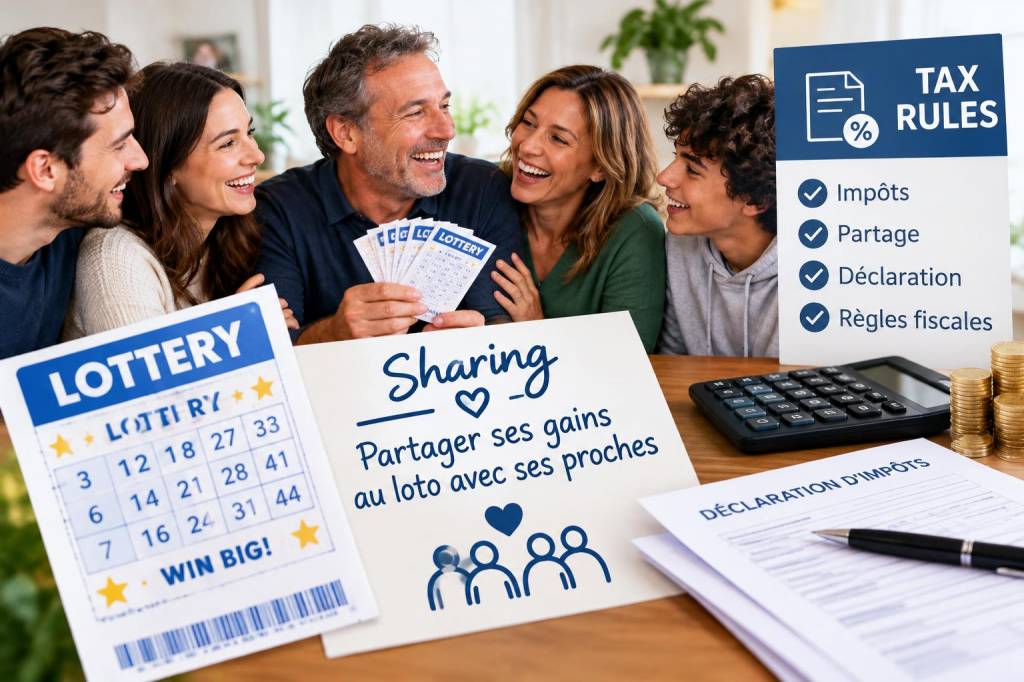
I remember the morning a close friend called me after a small-town headline announced a local lottery winner. We talked about the immediate joys — plans, relief, and the impulse to partager ses gains au loto avec ses proches. That impulse is powerful and natural. But as someone who writes about personal finance, I also know that generosity without a plan can create tax complications, family friction, or even legal headaches. In this article I walk you through what matters when you decide to share lottery winnings with family or friends in France: the fiscal rules, practical steps, behavioural tips, and common pitfalls.
Why people choose to share lottery winnings
When someone wins a lottery, the emotional pressure to distribute money quickly is intense. In my experience the motivations fall into a few buckets:
Emotional reciprocity — repaying years of support from parents or a partner.Practical need — helping family members with debt, home improvements, or medical bills.Estate planning — making lifetime gifts to reduce future inheritance conflicts.Tax or strategic reasons — using exemptions to reduce future taxable estate.Understanding your motives helps shape the method: a one-off bank transfer, formal donation, loan, or creation of a trust/holding structure all carry different legal and tax consequences.
Key fiscal rules in France: what you must know
First, a clarification: lottery winnings themselves are not treated as taxable income in France when received — they’re paid net by the lottery operator (e.g., Française des Jeux). However, transferring part of that gain to third parties triggers gift (donation) rules. Here are the essentials I always check:
Donations between living persons are subject to allowance thresholds and potentially to gift tax after those allowances are exceeded.Allowances depend on the relationship: for example, parents-to-child and spouse allowances differ from gifts to siblings or unrelated persons.Gifts can be in cash or in kind; both are treated similarly for taxation.Useful official references I consult include the tax administration guide on lottery gains and donations, the public-service guidance on donations, and legal texts on gift taxation:
Impot.fr: Gain loto — donation à la familleService-public.fr: DonationsLegifrance (tax code and legal references)Allowances and tax rates — practical numbers (2024 reference)
To make decisions I look at the concrete thresholds. These change over time, so I always verify the current year. As of recent rules, common allowances include:
Between parents and children: an allowance of €100,000 per parent per child (every 15 years).Between spouses or PACS partners: an allowance of €80,724 (varies by year and conditions).Between siblings: smaller allowances, often around €15,932.To non-relatives: a much lower allowance, typically €1,594.Beyond allowances, progressive rates apply depending on the remaining taxable amount. I recommend checking the official pages above or consulting a notary for precise current brackets.
Common ways to share winnings — pros and cons
When deciding how to distribute money, I evaluate three common approaches:
Direct gift (donation manuelle) — immediate cash transfer to a recipient. Fast and emotionally satisfying, but it must be declared if above allowances and may trigger gift tax.Formal donation (acte notarié) — a notarised gift. More expensive upfront (notary fees) but legally secure and transparent; useful for large sums or when attaching conditions.Loan agreement — you lend the money with a written contract. Not technically a gift; if interest-free or low-interest, tax authorities may scrutinise whether it’s a disguised donation.Practical checklist before you share
I never advise acting on emotion alone. Here’s my checklist I go through or recommend you go through:
Verify the legal holder of the ticket and the exact payout process with the lottery operator (FDJ for French national draws).Set a clear intention: gift, loan, or intermediary support (rent, mortgage payments, etc.).Calculate use of allowances: can you spread gifts across several years/parents to stay under thresholds?Record transfers in writing — even informal donations should be documented with bank transfers and a written note.Consider a notary for large donations to avoid later disputes.Case examples and numbers
Here are three short scenarios I often analyse with clients and friends:
Small donation — You win €50,000 and give €5,000 to each of three siblings. No gift tax applies if under the non-relative allowance? Be careful: siblings have a fixed allowance (~€15,932). So these €5,000 gifts are under the sibling allowance and no tax is due.Large parental gift — You win €1.2M and want to split €300,000 to each of your two children. With a €100,000 allowance per parent-child every 15 years, the taxable base would be €200,000 per child (unless you use married couple allowances or stagger gifts). Progressive rates then apply.Loan vs. gift — You “lend” €200,000 interest-free to a friend. Tax authorities may challenge that as a disguised gift if no repayment plan exists. Always document repayment terms.Table: Simplified donation allowances and typical tax implication
| Relationship | Typical allowance (approx.) | When tax applies |
| Parent → Child | €100,000 (per parent, every 15 years) | Tax applies on amount above allowance at progressive rates |
| Spouse / PACS | ~€80,724 | Tax applies if exceeded |
| Sibling | ~€15,932 | Tax applies if exceeded |
| Unrelated person | €1,594 | Tax applies quickly due to small allowance |
Reporting obligations and timing
When you make a donation you may have to declare it to the tax authorities within a set period. I always recommend:
Making transfers through traceable bank channels (no cash for large sums).Filing the donation form with the tax office if applicable (notary often handles this for formal acts).Keeping copies of all documents: proof of transfer, written agreements, notary acts.Behavioural and family governance tips
Money changes dynamics. From my experience the most important non-legal step is communication and rules:
Set expectations before transferring funds — explain whether a gift is conditional or final.Use written agreements for significant transfers to avoid misunderstandings later.Consider staged payments or housing the money in a shared vehicle (e.g., family company) if you worry about misuse.Seek independent advice: a notary for legal structure, a tax advisor for optimisation, and sometimes a mediator for family discussions.Statistics and probability perspective
It’s helpful to keep perspective: odds and behavioural data matter. For example:
Odds of winning a major national jackpot are typically one in several million — the European lottery odds vary, but many draws have odds worse than 1 in 10 million for top prizes (source: Française des Jeux).Surveys show many winners (approx. 20–30% in some studies) report relational strain within a few years without formal planning (statistic indicative — family finance research).Knowing how rare a win is and how common disputes are helps me plan more conservatively and with documentation.
Where to get professional help
I always recommend consulting specific professionals depending on your needs:
Notary (notaire): formalise large donations and advise on inheritance consequences.Tax advisor (expert-comptable or avocat fiscaliste): optimise allowances and report correctly.Financial advisor: invest large sums prudently to preserve wealth.Legal counsel or mediator for complex family arrangements.Useful further reading
Impot.fr guide on lottery gains and donations — official and practical: partager ses gains au loto avec ses proches.Service-public.fr on donations and successions: Donation: formalities and tax.Française des Jeux (FDJ) — payout process, winner protection: fdj.fr.