How to build a taxable-to-IRA Roth conversion ladder using Vanguard funds to optimize lifetime tax drag

How to build a taxable-to-IRA Roth conversion ladder using Vanguard funds to optimize lifetime tax drag

I often get asked how to reduce lifetime “tax drag” — the cumulative hit that taxes impose on investment returns — without sacrificing flexibility. One elegant, underused approach is a taxable-to-IRA Roth conversion ladder built around tax-efficient Vanguard funds. In this article I’ll walk you through how I’d construct this ladder, the practical mechanics, pitfalls to avoid, and example allocations so you can see how it works in the real world.

What I mean by a taxable-to-IRA Roth conversion ladder

Briefly: you use investments in a taxable account as a bridge while performing phased Roth conversions of traditional IRA balances. The goal is to smooth and minimize taxes over time (reducing lifetime tax drag) while keeping cash/liquidity needs covered by the taxable account. A well-designed ladder optimizes the tax-efficient characteristics of Vanguard funds and respects IRS rules like the five-year Roth holding period and RMD interactions.

Why this strategy reduces lifetime tax drag

Taxes act like a persistent negative return that compounds over decades. By converting to Roth strategically — when marginal tax rates are low, when you can fill low-tax brackets, or when you expect higher future taxes — you pay tax now to remove future tax drag on growth. Using your taxable account for interim spending avoids withdrawing converted Roth funds during the five-year window or creating unwanted taxable events. Vanguard’s tax-efficient index funds minimize realized gains in the taxable account, further limiting yearly taxes while keeping money accessible for ladder timing.

Key constraints and tax rules to keep in mind

Before you start, remember:

  • You pay ordinary income tax on traditional IRA-to-Roth conversions (unless the IRA basis is non-taxable), so plan conversions to fit into favorable marginal brackets.
  • Converted amounts are subject to the five-year rule for penalty-free distributions of converted funds if you’re under 59½ (each conversion has its own five-year clock unless you’re over 59½).
  • Required Minimum Distributions (RMDs) from traditional IRAs (starting age 73 as of my latest update) complicate conversions if you delay — you can’t convert amounts you must take as RMDs.
  • Taxable accounts have their own capital gains and dividends tax events; choose funds and trading habits that minimize current-year taxes.
  • Why Vanguard funds are a good fit

    Vanguard funds are appealing for this plan because many are tax-efficient index funds with low turnover (low capital gains distributions) and minimal expense ratios. Examples I use frequently:

  • VTSAX (Vanguard Total Stock Market Index Admiral): broad U.S. equity exposure, highly tax-efficient.
  • VFIAX (Vanguard 500 Index Admiral): S&P 500 exposure, also very tax-efficient.
  • Vanguard Total Bond Market Index (VBTLX) or short-term bond funds for cash-like stability in the taxable account.
  • VGSLX (Vanguard Real Estate Index Admiral) if you want REIT exposure — but be aware REIT dividends are often less tax-efficient. Hold REIT exposure preferably in tax-advantaged accounts.
  • Step-by-step: building the taxable-to-IRA Roth conversion ladder

    Here’s the workflow I follow when constructing a ladder with Vanguard funds.

  • 1) Assess your cash needs and timeline. Decide how many years you expect to bridge before the Roth funds become your primary source (or before you start tapping Roth conversions). Typical ladders span 3–10 years depending on age and income.
  • 2) Size the taxable buffer. Keep 2–5 years of expected withdrawals in a conservative, tax-efficient taxable mix (cash, short-term bond funds like VBTLX, and a portion of VTSAX if you accept some volatility). This reduces sequence-of-returns risk while limiting capital gains realizations.
  • 3) Map conversion tranches. Determine an annual conversion amount that fits inside a low tax bracket. For example, convert only what keeps your taxable income within the 12% or 22% bracket.
  • 4) Execute conversions annually or semi-annually. Convert the planned IRA amounts to Roth and pay the tax from non-retirement funds (ideally outside the IRA to avoid shrinking the tax-deferred base). Use funds in your taxable account to cover the tax bill.
  • 5) Replenish the taxable buffer strategically. After paying taxes, rebuild the taxable account using new contributions or by harvesting tax-efficient gains from Vanguard index funds when suitable.
  • 6) Monitor RMDs and pivot. Once RMD age approaches, re-evaluate: convert more aggressively earlier, or accept RMDs and focus Roth conversions on any remaining balances.
  • Example illustration (simple numbers)

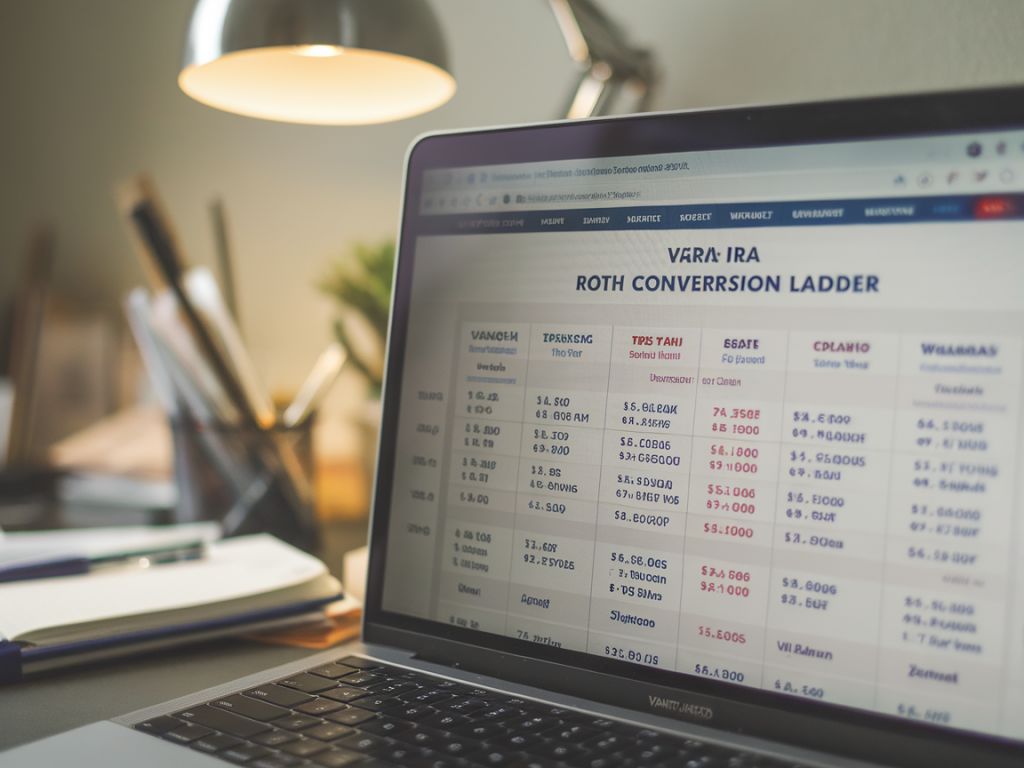
    Below is a simplified table showing a 5-year ladder example for a 60-year-old with $500k in a traditional IRA and $100k in taxable accounts. Assumptions: conversions limited to $50k/year to stay in a favorable tax bracket; taxable buffer used for taxes and living costs; Vanguard funds used for taxable holdings.

    YearIRA ConvertedTax Paid (approx)Taxable Account Remaining
    Year 1$50,000$12,500$87,500
    Year 2$50,000$12,500$75,000
    Year 3$50,000$12,500$62,500
    Year 4$50,000$12,500$50,000
    Year 5$50,000$12,500$37,500

    This is illustrative: you’ll want to replace the tax rates and bracket thresholds with current-year numbers and personalize contribution/conversion size. The taxable account balance is shown declining because it funds taxes and living costs until Roth assets are available and penalty-free.

    Portfolio construction choices inside the taxable account

    In the taxable sleeve I favor funds that minimize annual taxable distributions:

  • Core equities: VTSAX or VFIAX (low turnover, minimal capital gains distributions).
  • Short-term income buffer: Vanguard Short-Term Treasury or VBTLX for lower volatility and liquidity.
  • Avoid holding high-yield/reit-heavy funds (like VGSLX for REITs) in taxable unless you’re willing to accept less tax efficiency; instead put REIT exposure in the Roth/IRA portion.
  • Practical tax management tips I use

  • Harvest tax-losses opportunistically within the taxable account to offset realized gains and reduce the effective tax bill during conversion years.
  • Pay conversion taxes from the taxable account, not from the IRA — preserving the compounding power of retirement assets inside the IRA/Roth.
  • Coordinate conversions with other sources of low-tax income (e.g., years of low earned income, early retirement years, minus Social Security) to maximize use of lower tax brackets.
  • Keep records of each conversion year for five-year rule tracking and accurate basis reporting on your tax return.
  • When this approach is not ideal

    If you don’t have a meaningful taxable buffer or you expect significantly lower tax rates in the future (e.g., planned move to a low/no-tax jurisdiction), aggressive conversions today may not yield a net benefit. Also, if you’re within a few years of RMD age and lack flexibility, conversions become more complex and may generate higher short-term tax bills.

    If you want, I can create a custom conversion schedule using your current IRA balance, taxable buffer, expected spending needs, and projected tax rates — and show how Vanguard fund choices influence the taxable account’s expected distributions over your ladder timeline. Tell me your rough numbers and I’ll run through an example you can adapt.


    You should also check the following news:

    Investment Tools

    How to securitize rental income with a rent-backed note to scale multifamily acquisitions without dilution

    26/08/2026

    When I first explored creative financing to scale multifamily acquisitions without giving up equity, I kept coming back to one idea: why not package...

    Read more...
    How to securitize rental income with a rent-backed note to scale multifamily acquisitions without dilution