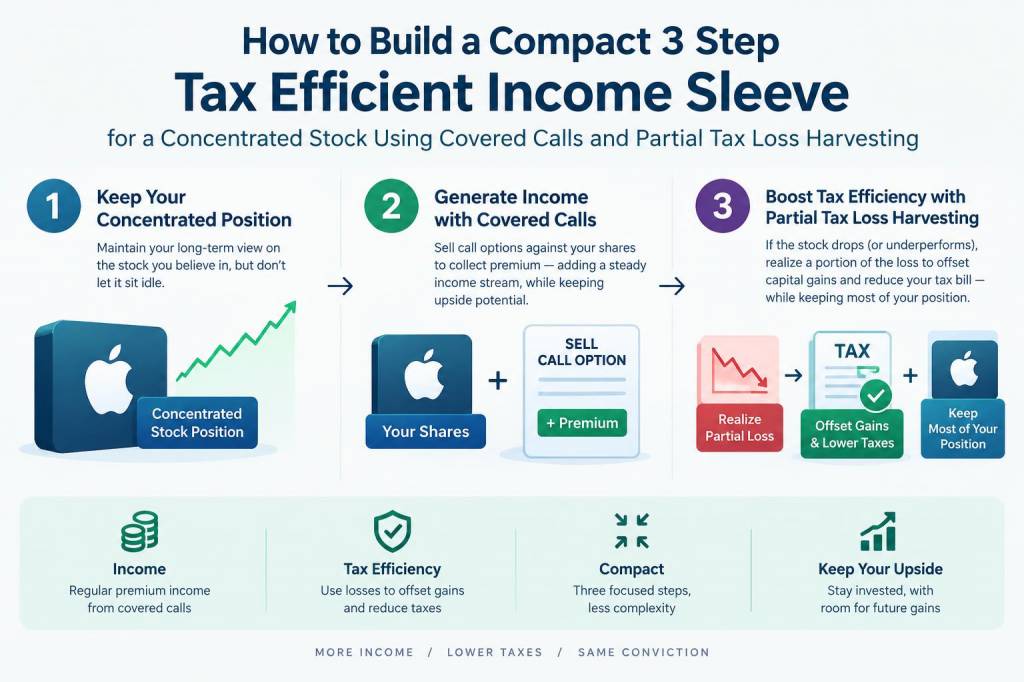
I’ve often been asked by investors who hold a concentrated position in a single stock: “How can I generate current income from this position without selling a lot of shares and triggering a big tax bill?” Over the years I’ve used a compact, repeatable framework that combines covered calls with selective, partial tax-loss harvesting to create an income sleeve around a concentrated holding. It’s designed to be simple, tax-aware, and scalable — especially useful when you want to reduce downside risk or monetize a view that the stock is range-bound in the near term.
Why build a tax-efficient income sleeve?
Concentrated stock positions create several common problems: high portfolio risk, emotional attachment, and potentially sizable tax implications if you liquidate. My goal with an income sleeve is to:
Generate premium income to offset opportunity cost or marginReduce effective cost basis over time through premiums and selective harvestingPreserve upside (to an extent) while lowering downside exposureCompared with simply selling shares, covered calls + partial tax-loss harvesting can be more tax-efficient because you collect option premium up front and can strategically realize losses on smaller lots rather than triggering a large capital gains event.
Overview of the 3-step approach
I use three compact, repeatable steps that fit into a monthly/quarterly cadence:
Slice the position into tranches. Keep inventory in lots that make selective harvesting and options management clean.Sell covered calls on a portion of the shares. Use expirations and strikes that align with your income target and upside tolerance.Partial tax-loss harvesting. Harvest losing lots strategically to offset gains and to reset cost basis, while using buy-backs or substitutes when necessary to maintain exposure.Step 1 — Position sizing and tranching
Practical tranching is the foundation. I start by dividing the concentrated position into three logical buckets:
Income tranche (40–60%): Primary target for covered calls. Enough size to produce meaningful premium without giving up all upside.Core tranche (20–40%): Long-term hold, minimal option activity, preserves upside and long-term capital gains profile.Harvest tranche (10–20%): Small lots (e.g., 25–100 shares depending on position size) reserved for tax-loss harvesting or active adjustment.Example: If you own 2,000 shares, I might designate 1,000 shares to income, 700 to core, and 300 to harvest. The exact split depends on conviction, tax situation, and liquidity.
Step 2 — Covered calls that fit the tax picture
Covered calls are my preferred tool to convert concentration into income without immediate sale. But the specifics matter:
Choose realistic strike and duration: I typically sell 30–60 day calls or monthly expirations for steady income. For income tranche I often pick strikes 3–10% above the current price if I want some upside, or at-the-money if premium is the priority.Avoid accidental short-term trading rules: If you’re using margin or certain accounts, be mindful of pattern day trader or short-term rule impacts.Manage assignment risk: If you’re comfortable selling shares, higher strikes or shorter durations reduce assignment probability. If you don’t want to be assigned before long-term holding periods, structure exposures with that in mind.Collecting premium reduces your effective cost basis. For example, a $2 premium on a $100 stock lowers your effective basis by 2% for the shares covered. Repeatedly selling calls can compound that benefit, though it also caps upside to the strike level when assignment occurs.
Step 3 — Partial tax-loss harvesting mechanics
Tax-loss harvesting is powerful when applied selectively. The idea is to realize losses on the harvest tranche to offset gains (or up to $3,000 of ordinary income per year) while maintaining market exposure. Key rules and my practical steps:
Identify loss lots: Use lot-level accounting (FIFO, Specific ID, etc.). I recommend Specific ID to control which lots you sell.Sell only the harvest tranche lots that are at a loss: This avoids disturbing long-term lots unnecessarily.Respect wash-sale rules: If you want to maintain exposure, buy a similar but not “substantially identical” replacement (e.g., a broad ETF, or options position) or wait 31 days. I often use a non-identical replacement like an industry ETF (e.g., XLK vs. AAPL) or a call option as a replacement.Use realized losses strategically: Offset gains generated from option assignment or other taxable events.Partial harvesting is done opportunistically — not every downturn warrants a sale. I look for tax-loss opportunities that produce meaningful tax offsets relative to trading costs and friction.
Example implementation (illustrative)
| Item | Value |
|---|
| Shares owned | 2,000 |
| Income tranche | 1,000 shares (sell monthly calls) |
| Core tranche | 700 shares (hold) |
| Harvest tranche | 300 shares (lot-level harvesting) |
| Monthly covered call premium (avg) | $0.80 per share → $800/month |
| Annualized premium (approx) | $9,600 (~1.2% monthly × 12 = 9.6% on income tranche) |
| Potential realized losses harvested | $5,000 (used to offset gains) |
Practical trading and tax tips
I use these operational practices to keep the sleeve efficient:
Specific lot identification: Use brokers that support Specific ID (Schwab, Fidelity, Interactive Brokers). It’s crucial for selective harvesting.Tax-aware trade logs: Keep clear records of option premiums, assignments, and realized gains/losses. Tools like GainsKeeper or your broker’s reporting help.Replacements for wash-sale compliance: If you want continuous exposure, buy a non-identical ETF or place a deep-in-the-money call as a substitute. Document intent and dates.Consider account type: Options and harvesting behave differently in taxable vs. tax-advantaged accounts. Don’t attempt harvesting inside IRAs — wash-sale rules don’t apply the same way and some substitution trades can create locked-in tax consequences.Common questions I get
What if the stock runs away to the upside? Covered calls cap upside on assigned shares; keep a core tranche untouched if you want unlimited participation. You can also roll calls higher when momentum resumes.How often should I harvest? I harvest when losses are material relative to trading costs and when I have tax needs (offsetting gains or ordinary income). Quarterly reviews work well.What about liquidity and option spreads? Use liquid strikes and expiries — avoid wide bid-ask spreads. Use limit orders and consider using brokers with good options executions (e.g., Tastyworks, Interactive Brokers).Tools and platforms I use
For trade execution and record-keeping I rely on a mix of platforms:
Interactive Brokers for advanced options and Specific ID lot managementSchwab/Fidelity for consolidated tax lots and tax reportingPortfolio rebalancing tools and spreadsheets (I build a simple Excel template to track tranche P&L and annualized yield)If you want, I can share the spreadsheet template I use to model premiums, assignment probabilities, and post-premium effective cost basis across tranches — it’s how I keep the sleeve compact and repeatable.