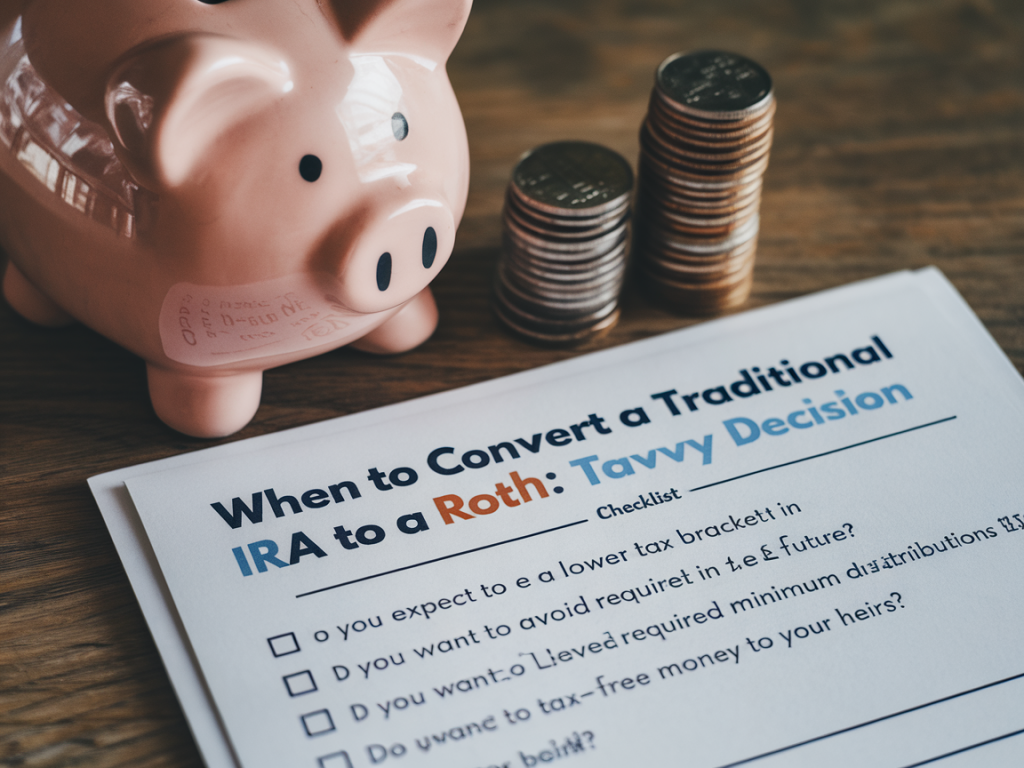
I convert retirement accounts for the same reason I study market cycles: to tilt the odds in my favor while keeping downside controlled. A Traditional IRA-to-Roth conversion can feel like a one-way door — you pay taxes today to secure tax-free growth and withdrawals later — so the question I ask myself (and every client) is: when does paying that tax now make more sense than deferring it?
Why a conversion matters
A Roth IRA grows tax-free and qualified withdrawals are tax-free for life. That advantage is potent for long investment horizons, high expected future tax rates, or if you want to leave assets to heirs without required minimum distributions (RMDs). But you don’t get the tax break on the converted amount — you pay ordinary income tax in the conversion year. The decision comes down to comparing taxes now vs. taxes later, plus a few behavioral and planning considerations.
Quick, practical checklist: When to seriously consider a conversion
- Your current marginal tax rate is low: If you have a year of unusually low income (sabbatical, job loss with unemployment benefits, retirement before Social Security), converting while you’re in a lower bracket reduces the tax hit.
- You expect higher future tax rates: If you believe your tax bracket in retirement will be higher (because of larger taxable income, reduced deductions, or legislative tax increases), locking in today’s rate can be beneficial.
- You have a long time horizon: The longer the money can grow tax-free, the more you benefit. Ten to fifteen years is a common breakpoint where conversions often pay off, depending on expected returns and tax differentials.
- You can pay the conversion tax with non-retirement funds: Using outside cash to pay the tax preserves the full balance of the Roth for tax-free growth. Paying with IRA funds reduces the conversion benefit and may cause penalties if you’re under 59½.
- Estate planning matters: If you plan to leave retirement assets to heirs, Roths can be attractive: beneficiaries avoid income tax on distributions (though new 10-year rules and other changes may affect timing).
- You want to avoid (or minimize) RMDs: Roth IRAs are not subject to RMDs during the original owner’s lifetime, which gives you flexibility in withdrawals and tax planning.
- You can use a conversion ladder: If you anticipate retirement before 59½ and need access to funds, a series of conversions over several years can create penalty-free access after five-year holding periods.
- You’re using a backdoor Roth strategy: If you exceed Roth income limits and use nondeductible Traditional IRA contributions, be careful with conversions because of the pro-rata rule — pro-rata calculations can create unintended tax consequences.
How to evaluate the tax math (simple framework)
I like to keep the math intuitive. Start with these steps:
- Estimate your current marginal federal (and state) tax rate if you convert X dollars.
- Estimate your expected marginal rate in retirement.
- Project an expected annual return on the converted amount.
- Compare after-tax values at a reasonable future date (for example, 10–15 years).
Example: convert $50,000 at a 22% combined federal/state tax this year. You pay $11,000 tax and move $39,000 into a Roth. If the account grows at 6% annually for 15 years, the Roth becomes roughly $99,000 tax-free. If instead you left the $50,000 in a Traditional IRA, it would have grown to about $126,000 but be taxable at withdrawal — if taxed at 22% then you keep about $98,280. In this simplified example the Roth wins by a small margin. Swap assumptions (higher growth, lower future tax rate, or shorter horizon) and the result changes.
Common pitfalls and how I avoid them
- Underestimating the current tax bill: Conversions can push you into a higher bracket or phase you into costly surcharges (Net Investment Income Tax, Medicare IRMAA surcharges). I run multiple scenarios to see thresholds.
- Pro-rata rule surprises: If you have any pre-tax Traditional IRA balances and nondeductible contributions, the IRS taxes conversions on a pro-rata basis. That can make “clean” backdoor Roths messy. The workaround is to consolidate pre-tax IRAs into an employer plan (401(k)) if allowed, before converting nondeductible amounts.
- Using IRA funds to pay taxes: That reduces the converted principal and can create early-withdrawal penalties if you’re under 59½. I usually recommend paying taxes from a taxable account.
- Ignoring state taxes: Some states tax conversions; others don’t. If you live in a high-tax state but plan to move to a no-tax state in retirement, that matters.
Timing strategies I’ve used
From a practical standpoint I favor bite-sized, year-by-year conversions rather than a single large conversion unless you’re certain the math favors a one-time move. Here are tactics I employ:
- Bracket filling: Convert only up to the top of a target marginal bracket each year. For example, if you’re in the 12% bracket and don’t want to cross into 22%, convert enough to hit the 12% ceiling.
- Strategic low-income years: Use years with lower income to convert larger amounts (e.g., early retirement before Social Security/RMDs start, or during a job transition).
- Market timing vs. tax timing: If markets are down, converting can be more efficient — you pay tax on a lower account value, then benefit from tax-free recovery. I don’t chase market timing, but downturns are good opportunities.
- Partial conversions for flexibility: Smaller conversions keep options open and let you adapt to changing tax laws or personal circumstances.
How I run scenarios
I run at least three scenarios: a base case, an optimistic growth/higher future tax case, and a pessimistic lower-growth/lower-future-tax case. Key inputs are expected return, years to withdrawal, current and future marginal tax rates, and state taxes. Many online calculators — Vanguard, Fidelity, or Schwab — are useful starting points. For more control, a simple spreadsheet projecting pre-tax vs. after-tax values is enough.
Who should avoid conversions (or be cautious)
- Those who can’t pay the conversion tax from outside funds.
- People close to retirement without enough time for tax-free growth to compensate.
- Anyone with complex IRA ownership situations where the pro-rata rule will create a big tax surprise.
- Those expecting large deductions or credits in a future year that would otherwise lower their effective tax rate.
Quick comparison table: Traditional IRA vs Roth after conversion
| Feature | Traditional IRA | Roth IRA (after conversion) |
|---|---|---|
| Tax on contributions | Pre-tax (deductible) | After-tax (paid at conversion) |
| Growth | Tax-deferred | Tax-free |
| Withdrawals in retirement | Taxable | Tax-free (qualified) |
| RMDs | Required | Not required (owner’s lifetime) |
| Estate planning | Tax burden for heirs | Potential tax-free legacy |
Practical next steps I recommend
- Run a simple scenario for 5, 10, and 15 years with your expected return and tax rates.
- If you have nondeductible contributions, check the pro-rata rule — consider rolling pre-tax IRAs into a 401(k) if available.
- Plan conversions to avoid crossing into higher Medicare premiums or other surtax thresholds.
- Pay conversion taxes from a taxable account whenever possible.
- Consider spreading conversions over several years to smooth tax impact.
- Talk to a tax advisor if you have complex income, state tax issues, or estate-planning goals.
Deciding to convert a Traditional IRA to a Roth is both a numbers game and a planning decision. The math can be straightforward, but the variables — future tax policy, life events, investment returns — add uncertainty. I aim to structure conversions so they give you optionality: lock in tax-free growth where it makes sense, keep some assets flexible, and avoid big surprises from pro-rata calculations or bracket creep. If you want, I can walk you through a tailored scenario with your numbers and show the break-even horizon for your situation.