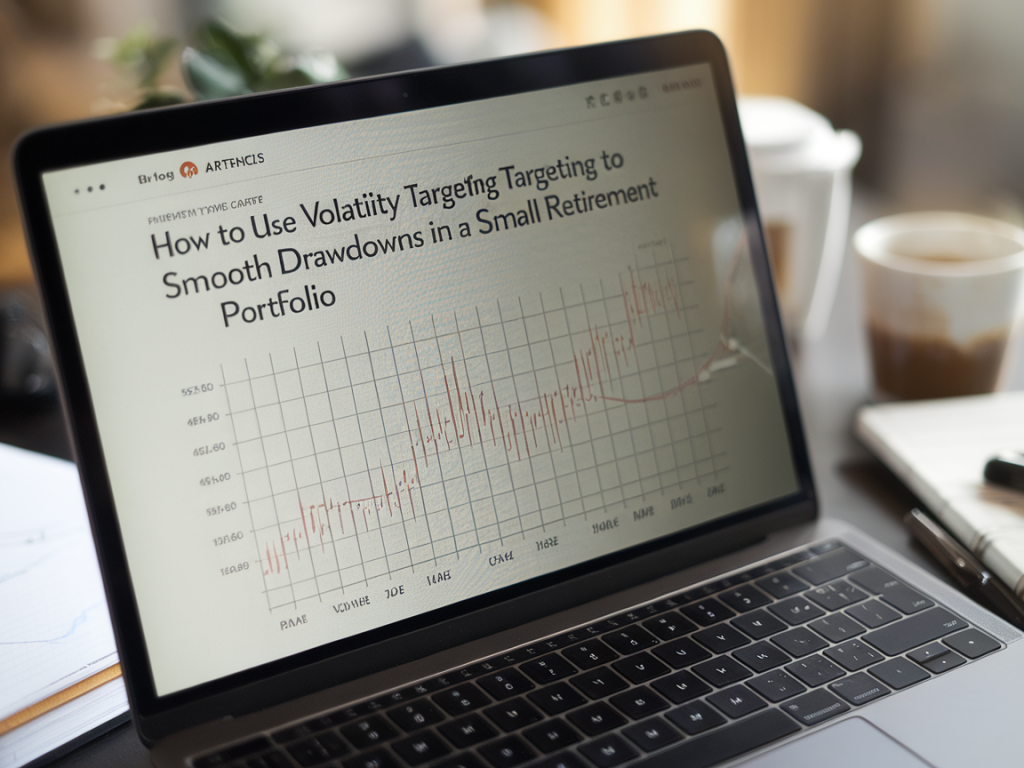
How to use volatility targeting to smooth drawdowns in a small retirement portfolio

How to use volatility targeting to smooth drawdowns in a small retirement portfolio

I often get questions from readers who are approaching retirement with a relatively small nest egg and a big fear of sequence-of-returns risk: “How can I avoid a large drawdown in the early years of retirement?” Volatility targeting is one practical technique I use and recommend to help smooth drawdowns while keeping a meaningful allocation to growth assets. In this article I’ll walk you through what volatility targeting is, why it matters for a small retirement portfolio, and exactly how I implement it in a cost-aware, tax-aware way.

What is volatility targeting and why it helps retirees

Volatility targeting is a dynamic portfolio sizing rule: instead of keeping fixed percentage allocations (for example 60% stocks / 40% bonds), you adjust the exposure to the risky asset so that the portfolio’s expected or realized volatility stays near a predetermined target. When markets calm you increase exposure to stocks; when markets spike you reduce exposure. The goal is not to time returns, but to smooth realized volatility and reduce the probability of large early drawdowns that can cripple a small retirement balance.

For retirees with a small portfolio, drawdowns are particularly dangerous because withdrawals during a downturn permanently lower the base from which future gains compound. Volatility targeting reduces the size of those drawdowns and can improve the “sustainability” of withdrawals. It’s a pragmatic way to balance growth and protection without having to sell into panic or adopt an overly conservative static asset mix.

Core elements of a volatility-targeted strategy

Here are the components I use when I design a volatility-targeted plan for a retiree portfolio:

  • Risky asset — typically a broad equity ETF (e.g., SPY, VTI, or a total world ETF like VT) or a mix of domestic and international equity ETFs.
  • Defensive asset — high-quality bonds or bond ETFs (e.g., AGG, BND, TLT for duration exposure) or short-term Treasuries depending on cash needs and interest-rate views.
  • Volatility estimator — a rolling standard deviation of returns (common windows: 60–120 trading days) or an exponentially weighted volatility.
  • Target volatility — a volatility level you want your risky exposure to exhibit (common targets: 8%, 10%, 12% depending on risk tolerance).
  • Leverage/cash cap — maximum allowed multiplier on risky asset (often 0–2x) and a minimum cash/bond buffer to avoid forced selling.
  • Rebalancing frequency — how often you adjust exposure (monthly or quarterly are practical for small portfolios to limit transaction costs).
  • Simple rule I use (step-by-step)

    My go-to volatility targeting rule for a small retirement portfolio is straightforward and implementable using a regular brokerage account and ETFs:

  • Choose a risky equity proxy (I often use VTI or a combined 50/50 VTI/VEA for small portfolios to control home bias).
  • Estimate realized volatility = annualized standard deviation of daily (or weekly) returns over the last 60 trading days.
  • Calculate allocation to equities = Target Volatility / Estimated Volatility, capped between 0 and a maximum (for example 150%).
  • Multiply that allocation by your “risky allocation weight” (e.g., if you want a baseline equity exposure of 60% at the target volatility, set equity weight = 0.6 × (Target/EstVol)).
  • Invest the remainder in short-duration bonds or cash. Rebalance monthly.
  • Example: Target volatility = 10%. Estimated equity vol = 20%. Equity allocation = 0.6 × (10/20) = 0.3 → 30% in equities, 70% in bonds. If equity vol drops to 12%, allocation = 0.6 × (10/12) ≈ 50% equities.

    Practical implementation details

    Here are the practical choices that make this work for a small retirement account:

  • Use ETFs with low costs — expense ratios matter when the portfolio is small. I prefer broad low-cost ETFs (VTI, VXUS, SCHB, AGG).
  • Rebalance monthly or quarterly — monthly gives a good balance between responsiveness and transaction costs. Quarterly is fine if you prefer less turnover.
  • Keep a cash buffer — maintain 3–6 months of expected withdrawals in cash or ultra-short Treasuries to avoid selling into a downturn.
  • Watch taxes — do volatility targeting inside tax-advantaged accounts first (IRAs, 401(k)s). If implemented in a taxable account, prefer ETFs that minimize taxable distributions and use tax-loss harvesting rules where practical.
  • Beware of leverage — avoid margin or leveraged ETFs for most retirees. If you use leverage, keep strict caps and understand the cost (interest on margin, tracking decay).
  • Example allocation table

    Estimated Equity Volatility (annual) Equity Allocation (target 10%, base weight 60%) Bonds/Cash
    25% 24% (0.6 × 10/25) 76%
    20% 30% 70%
    15% 40% 60%
    12% 50% 50%
    8% 75% (capped at 75% if you set max) 25%

    Risks, pitfalls and how I mitigate them

    Volatility targeting sounds attractive but it’s not a free lunch:

  • Model risk — historical volatility can change quickly. I prefer a conservative target and a short (60–120 day) lookback so the rule responds to regime changes.
  • Transaction costs and slippage — frequent rebalancing can be costly in small accounts. That’s why I default to monthly rebalance and cap portfolio turnover with a band (only rebalance if allocation differs by >2–3 percentage points).
  • Liquidity and leverage constraints — avoid using products that can blow up in stress (certain leveraged ETFs or illiquid ETFs). Stick to large-cap, high-volume ETFs.
  • Behavioral risk — you’ll still feel uncomfortable if you reduce equity exposure during a rally; remind yourself this is to limit downside risk, not to short-circuit growth opportunities.
  • Measurement and monitoring

    I use Portfolio Visualizer or a simple spreadsheet to compute rolling volatility and simulate the strategy before committing. If you’re comfortable with Python, a short script using pandas can compute a 60-day rolling std and apply the allocation rule. For non-programmers, brokers like Vanguard, Schwab, and Fidelity allow easy ETF trading and most portfolio trackers can help visualize allocations and rebalancing needs.

    When volatility targeting is most useful

    I find it most helpful for:

  • Retirees with small to medium portfolios who need growth but cannot tolerate large drawdowns.
  • Clients with a high withdrawal rate where sequence risk is a genuine threat.
  • Investors who want a rules-based framework to remove emotion from allocation decisions.
  • It’s less useful if you already have a very conservative glidepath, large guaranteed income (pensions, annuities), or if your portfolio is too small to justify the transaction cost overhead.

    If you’d like, I can share a sample spreadsheet (with formulas for the rolling volatility, allocation multiplier, and trade signals) that you can adapt to your ETFs and tax situation. I’ve used this approach in small retirement portfolios to reduce early-sequence drawdowns while preserving participation in recoveries — not perfect, but practical, evidence-driven, and implementable without exotic instruments.

    You should also check the following news:

    Portfolio Strategies

    How to size options positions for income strategies while controlling downside risk

    02/12/2025

    Generating steady income from options is attractive: premium flows, time decay working in your favor, and a wide menu of strategies from covered...

    Read more...
    How to size options positions for income strategies while controlling downside risk
    Portfolio Strategies

    What scenario analysis reveals about your portfolio’s glidepath toward retirement income

    02/12/2025

    I run scenario analysis on my clients’ retirement plans like a pilot runs checklists before takeoff: it’s not glamorous, but it’s the thing...

    Read more...
    What scenario analysis reveals about your portfolio’s glidepath toward retirement income