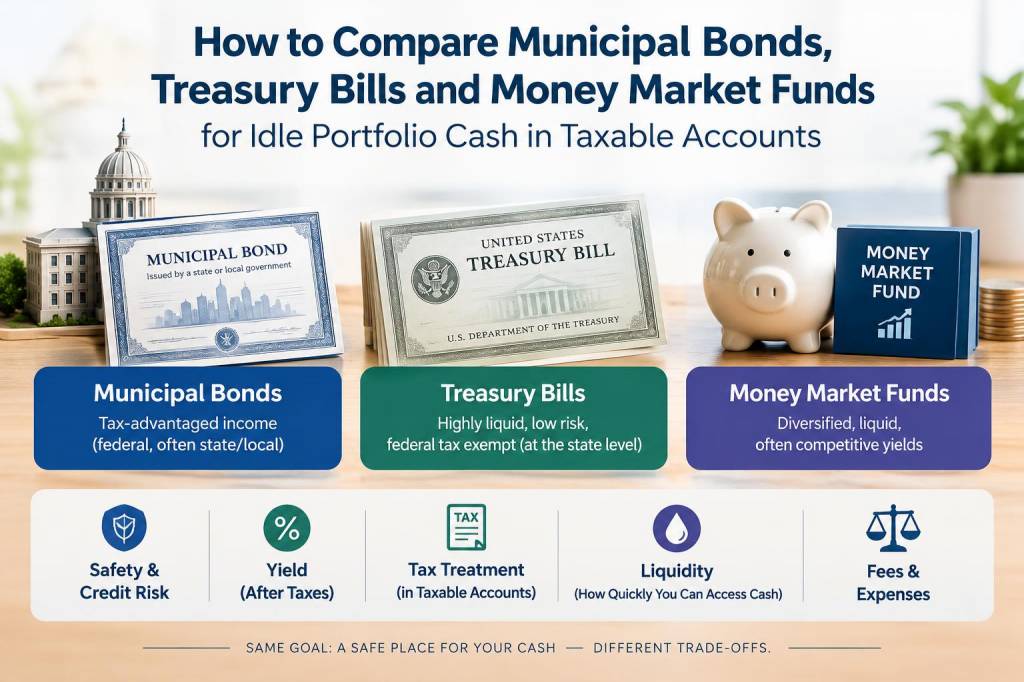
When I hold idle cash inside a taxable account, I do not leave it sitting still unless I have a very short-term need for it. Cash drag matters. Even a few weeks of uninvested money can reduce portfolio efficiency, especially when rates are moving and tax treatment changes the after-tax picture. Over time, I have found that three places deserve a serious comparison: municipal bonds, Treasury bills, and money market funds.
Each one can play a useful role, but they are not interchangeable. What looks like a small yield difference can disappear once I factor in taxes, state treatment, maturity risk, liquidity, and what happens if I need the money on short notice. In taxable accounts, I care less about headline yield and more about after-tax yield and practical access to cash.
What I mean by idle cash in a taxable account
By idle cash, I mean money that is waiting for a future investment, a tax bill, a home purchase, or simply a decision. It is not emergency money in a checking account, and it is not long-term capital that I plan to keep in equities or real estate. It is temporary capital that still needs to earn something.
In my own process, I separate that money by expected holding period. If I need the cash within days, I want immediate liquidity. If I may not need it for several months, I can consider short-duration instruments. If I know the money might sit for a year or more, I can be a bit more selective about yield and tax efficiency.
Why taxable accounts change the decision
In a tax-deferred account, I mainly compare gross yield, credit quality, and liquidity. In a taxable account, I have to think about federal tax, possible state and local tax, and in some cases capital gains treatment. That changes the ranking.
Municipal bonds can look attractive because interest may be exempt from federal tax, and sometimes state tax too. Treasury bills are simple and very high quality, and their interest is exempt from state and local tax, though not from federal tax. Money market funds offer convenience and daily liquidity, but their tax treatment depends on what they hold. A government money market fund is usually state-tax efficient, while a prime fund may distribute income that is fully taxable.
So I do not ask only, “Which one yields more?” I ask, “What do I actually keep after taxes, and how much flexibility do I lose to get it?”
Municipal bonds: useful, but not always as simple as they look
I like municipal bonds when I want tax efficiency and I am comfortable with a little more complexity. Their appeal is strongest for investors in higher federal tax brackets, especially if they also face a high state tax rate and can buy bonds issued in their home state.
The first thing I check is whether the bond is general obligation or revenue backed. General obligation bonds rely on the issuer’s taxing power, while revenue bonds rely on a specific revenue stream, such as tolls, water systems, or airports. Both can be useful, but the risk profile is different. I also look at maturity, call features, and credit quality. A tax-free coupon is not worth much if I am forced to accept too much credit risk or too much price volatility.
Municipal bonds can be especially attractive for investors who want to park cash for a few months to a few years and are willing to do a bit of research. Still, I have to respect the fact that a bond is a security, not a cash equivalent. If rates rise, the market value can fall. If I buy an individual muni with a long maturity, I am not treating it like a money market substitute. I am making a rate and credit decision.
I also pay attention to the taxable-equivalent yield. That matters because a muni yield that looks lower than a Treasury bill can still be better after taxes. The comparison depends on my marginal federal tax rate, state tax, and the exact structure of the bond. For investors in lower brackets, municipal bonds may not win after taxes, especially once spread, trading costs, and credit risk enter the picture.
Treasury bills: my benchmark for simplicity and safety
Treasury bills are often my reference point when I want a low-risk parking place for cash. They are backed by the U.S. government, they have short maturities, and they are highly liquid. If I want a very clean answer to “Where should I hold cash for a few weeks or a few months?” Treasury bills are usually near the top of my list.
One advantage I value is predictability. I can buy a bill with a defined maturity, hold it to maturity, and know exactly what I will receive if I do not sell early. That removes a lot of uncertainty. The interest is exempt from state and local taxes, which can matter a lot for investors in high-tax states.
Still, Treasury bills are not magic. Federal tax still applies to the interest, and if I need to sell before maturity, the market price can move. For very short holding periods, that is usually a minor issue, but it is still a market instrument, not a bank deposit.
When I compare bills with municipal bonds, I often think in terms of certainty versus tax advantage. Bills usually win on simplicity, liquidity, and credit safety. Munis can win on after-tax yield for higher-bracket investors. The choice depends on whether I want a nearly frictionless cash tool or a more tax-efficient fixed-income position.
Money market funds: convenience is their real edge
Money market funds are often the most convenient place to keep idle cash inside a brokerage account. I can buy and sell them easily, the share price is designed to stay stable, and many brokerage platforms use them as settlement vehicles. That convenience has real value when I want to move quickly.
I separate money market funds into two broad categories: government funds and prime funds. Government funds generally hold Treasury securities, repurchase agreements backed by government collateral, and other government-related instruments. Prime funds may hold short-term corporate paper and other private instruments. In taxable accounts, I often prefer government funds because they tend to be more tax efficient and usually align better with a conservative cash posture.
Money market funds are not identical to bank savings accounts. They are investment products, and although they aim to maintain stability, they are not insured bank deposits. That said, they are often extremely practical when I need same-day liquidity and do not want to manage individual securities.
From a tax angle, the distribution mix matters. If a fund generates mostly Treasury income, I may benefit from state tax exemption on that portion. If it holds other securities, the tax profile may be less favorable. I always look past the brand name and read the fund’s composition.
How I compare them in real life
When I am deciding among these three options, I use a simple sequence:
- I identify my holding period.
- I estimate my federal and state tax rates.
- I check whether I need same-day liquidity or can wait until maturity.
- I compare after-tax yield, not just stated yield.
- I review credit risk, call risk, and price volatility.
If I need cash in a matter of days, a money market fund or a Treasury bill ladder usually fits better than an individual municipal bond. If I know the cash may sit for several months and I am in a high tax bracket, a high-quality municipal bond or municipal money market fund may deserve attention. If I want near-zero hassle and very short duration, Treasury bills are hard to beat.
What surprises many investors is that the “best” choice can change with tax rates. A muni that looked attractive last year may no longer be attractive after a rate move or a tax change. A Treasury bill can become more competitive when yields rise. A money market fund can become better or worse depending on the securities it holds and how its distribution yield compares after taxes.
A simple comparison framework
| Instrument | Main strength | Main drawback | Tax angle in taxable accounts | Best fit |
|---|---|---|---|---|
| Municipal bonds | Potential federal and sometimes state tax exemption | Credit risk, rate risk, less simplicity | Can be highly efficient for higher-bracket investors | Longer cash parking when tax efficiency matters |
| Treasury bills | Safety, clarity, short maturity | Federal tax still applies | State and local tax exemption | Short-term cash with strong liquidity and low risk |
| Money market funds | Convenience and daily liquidity | Yield can trail direct bills; not insured bank deposits | Varies by fund type and portfolio holdings | Operational cash and very short holding periods |
Where I tend to place different kinds of cash
For cash I may need immediately, I usually favor a government money market fund or a Treasury bill that is very close to maturity. I want minimal friction and a clean path back into my portfolio.
For cash that I expect to deploy over the next few months, I often look at Treasury bills first because they give me a very direct balance of safety and liquidity. If I am in a high tax bracket and the numbers support it, I also study municipal options carefully.
For cash that may sit longer and where I can accept some complexity, municipal bonds become more interesting. In those cases, I focus on quality, maturity structure, and whether the tax benefit is real after I calculate my own situation. I do not buy a muni simply because it is tax free. I buy it because it improves my after-tax outcome without creating a problem I do not want.
Questions I always ask before I move cash
Is this money truly idle, or is it only temporarily idle before I invest it somewhere else?
How long can I afford to leave it untouched?
What is my marginal tax rate, and do I also face state tax?
Do I value absolute simplicity more than a slightly better after-tax yield?
Am I comfortable owning an individual bond, or do I want a pooled fund instead?
Do I care more about yield today, or about the ability to exit quickly if my plans change?
Those questions usually matter more than product marketing. Once I answer them honestly, the right choice becomes much clearer.
When I review idle cash inside a taxable account, I keep coming back to a few practical truths: municipal bonds can be excellent tax tools, Treasury bills offer a clean and reliable parking place, and money market funds provide operational ease that many investors underestimate. The right choice is rarely abstract. It depends on my tax bracket, my time horizon, and how much control I want over every dollar sitting on the sidelines.