I focus on CFE advance payment rules because, for many self-employed people and small businesses in France, this is one of those tax moments that is easy to postpone mentally and expensive to ignore in practice. The deadline is not just a calendar item; it changes cash flow, affects year-end planning, and can create avoidable stress if you do not understand what is due, when it is due, and which payment channel actually works.
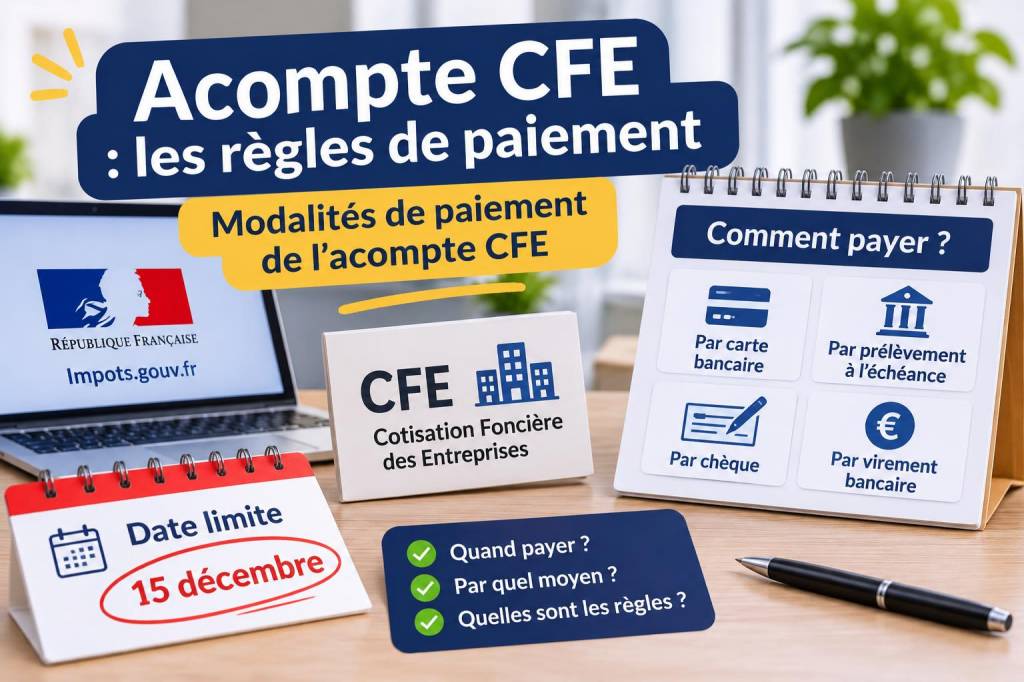
If I want a direct reference while checking dates, calculation logic, and filing details, I start with this resource: modalités de paiement de lacompte CFE. I use it as a practical entry point, then I cross-check it with official tax sources so I can separate what is obligatory from what is merely convenient.
What I pay attention to first
When I look at the CFE advance payment, I do not begin with the amount. I begin with three questions: Am I liable? Is an advance actually required this year? What payment method is accepted before the deadline? Those three points determine the rest of the process.
The CFE, or business property tax, is part of local business taxation in France. The advance payment usually concerns taxpayers whose CFE exceeds a certain threshold and who must pay a portion in advance before the final balance later in the tax cycle. In practical terms, that means I need to know whether I am dealing with a prepayment, a full payment, or simply a zero-due case because of exemptions or low liability.
One reason I stress this is cash planning. Even a moderate tax bill can matter if it lands close to payroll, rent, loan instalments, or inventory purchases. In my experience, a tax payment becomes a problem less because of its size than because it arrives at an inconvenient moment.
Payment timing and why date discipline matters
For business taxes, timing is rarely flexible. When the administration sets a deadline, I treat it as non-negotiable. Late payment can trigger penalties, surcharge risk, and interest. More importantly, if I miss a tax payment deadline once, I often end up spending more time cleaning up the issue than I would have spent making the payment on time.
For CFE advance payment planning, I track three timing layers:
That last point matters more than most readers expect. I never wait until the final day to discover that my tax account has not been updated, that a bank mandate is inactive, or that the amount displayed differs from what I expected.
According to the French tax administration, business taxes are increasingly managed through digital payment channels, and online account management is now the default route for many professional taxpayers. That shift matters because it reduces ambiguity: when I log in, I can see the amount, the due date, and the payment status in one place.
How I think about the calculation
The calculation is not always intuitive, so I prefer to simplify it into a few steps. I first identify the tax base, then I check the local rate, then I see whether any exemption, reduction, or cap applies. In many cases, the amount due is linked to the commune or intercommunal authority where the business is located, which means two businesses with similar activity can face different outcomes.
In broad terms, I watch for these elements:
That is why I dislike treating CFE as a flat fee. It is not flat. It is location-sensitive, activity-sensitive, and sometimes status-sensitive. A sole trader working from home may have a very different result from a company with premises, storage space, or a dedicated office unit.
In financial planning terms, I always recommend estimating the amount conservatively. If I expect a tax amount between two figures, I prefer to reserve the upper end. That small buffer can absorb local variation and prevent a liquidity squeeze.
Payment methods I would actually use
When I review modalities of payment, I care less about theoretical possibilities and more about what is reliable, traceable, and easy to prove. For me, the best payment route is the one that leaves a clean digital record and avoids confusion over settlement timing.
| Payment route | Practical strengths | My caution point |
|---|---|---|
| Online payment through the tax account | Clear record, fast confirmation, simple follow-up | Requires correct login access and up-to-date bank details |
| Direct debit | Reduces risk of forgetting the deadline | Bank mandate must be active in time |
| Scheduled payment | Useful for cash planning | Needs earlier preparation so the order is processed correctly |
If I want operational certainty, I prefer direct debit or another official online method because I can document the transaction. Paper-style or manual approaches create friction, and friction is exactly what I try to remove from tax compliance.
I also check whether the payment account is the same one used for other business taxes. In my own workflow, I avoid changing too many variables at once. If I change bank details, I do it well before the deadline, not during the payment window.
What I watch in the tax account
The tax account is where most mistakes become visible. I log in early and confirm a handful of items:
I also compare the notice with my own records. If I started, moved, closed, or changed activity during the year, I do not assume the tax record is automatically aligned. Administrative lag happens, and when it does, it can affect both the amount and the timing.
One practical rule I use: if the notice and my books disagree, I investigate immediately. I do not wait for the deadline to force the issue. That habit has saved me from avoidable late-payment risk more than once.
When the amount feels high
Sometimes the advance feels heavier than expected. When that happens, I do not jump straight to the conclusion that the bill is wrong. I first ask whether the taxable base changed, whether the local rate moved, or whether an exemption I relied on no longer applies.
Here is the sequence I use:
That approach keeps me from arguing with the number before I understand it. In tax matters, emotion is rarely efficient; documentation is.
Cash flow planning around the advance
I treat the CFE advance as part of my quarterly or annual liquidity calendar. That means I do not wait for the tax notice to begin reserving funds. I set aside a tax reserve alongside social charges, income tax provisions, and other recurring obligations.
For small businesses, this matters even more because revenue can be uneven. A strong month can mask a weak one, but tax deadlines do not care about revenue rhythm. If I run a seasonal activity, I make a point of smoothing the reserve over the months that generate cash, not the months that consume it.
I also like to compare the tax bill to revenue bands. For example, if the due amount is close to a meaningful percentage of one month’s turnover, I treat it as a strategic item, not a routine expense. That framing helps me avoid underestimating its impact.
Sources I trust when I verify the rules
I do not rely on a single page when I check tax payment rules. I compare several sources so I can separate official wording from explanatory commentary. These are the sources I usually start with:
I find that official sources give me the legal and procedural baseline, while editorial sources help me interpret practical implications. That combination is useful when I write for readers who need clear action, not just legal phrasing.
Figures and facts I keep in mind
A few numerical points are useful when I assess the importance of the payment process:
I also pay attention to the fact that local business taxation supports municipal and intercommunal budgets. That is one reason local rates matter so much: the tax is not only a compliance item, it is also part of how local public financing works.
What I would check before sending payment
Right before I pay, I run a short checklist. It is simple, but it prevents the majority of errors:
If I were managing several entities, I would also label each notice clearly and store the confirmation receipt in the accounting file. I like to think of tax proof as part of financial hygiene. If I cannot find a receipt quickly, I do not have real proof, only memory.
What I ask myself if I want to stay ahead next year
Once the payment is done, I do not close the file completely. I note the amount, the timing, and any surprises in a running tax log. That makes next year easier because I can see whether the tax changed because of my activity, my location, or the local authority’s rate.
I ask myself four questions:
Those questions matter because the real value of understanding CFE advance payment rules is not just compliance. It is control. When I understand the process, I reduce uncertainty, protect liquidity, and avoid last-minute decisions that usually cost more than they save.