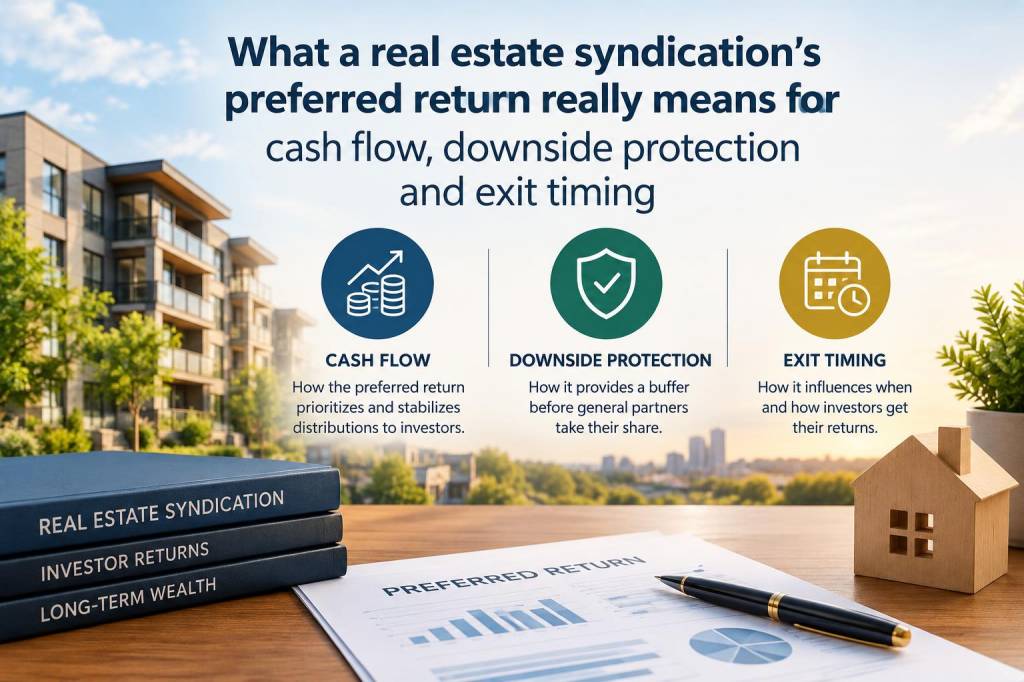
What preferred return really does in a syndication
When I evaluate a real estate syndication, one of the first phrases I look for is preferred return. It sounds reassuring, and in many cases it is meant to be. But I do not treat it as a promise of steady income, and I do not read it as a guarantee that I will be paid before anyone else under every possible outcome. In practice, a preferred return is a distribution rule, not a magic shield. It shapes who receives cash flow first, how much flexibility the sponsor has, and what may happen if a deal runs slower than expected.
In plain English, a preferred return sets a hurdle rate for the investors, often called limited partners. If a deal advertises an 8% preferred return, that usually means the investors are supposed to receive distributions until they have earned an 8% annual return on their contributed capital, subject to the exact operating agreement. That sounds simple, but I have learned that “preferred” can mean several different things depending on whether the return is cumulative, non-cumulative, compounding, or tied to a specific waterfall structure.
That is why I always read past the headline number. I want to know when the preferred return starts accruing, whether unpaid amounts stack up, whether current cash flow is actually being paid out or merely tracked on paper, and whether the preferred return must be satisfied before any performance split kicks in. Those details determine whether I am looking at a true income-first structure or a softer marketing term that sounds more protective than it really is.
Cash flow: what investors actually receive during ownership
Preferred return matters most to me when I ask a simple question: Will I receive cash flow early, or will most of it stay inside the deal? In a strong property with ample rental income, a preferred return can function like a priority lane. Investors may receive distributions up to the preferred rate before the sponsor participates in upside economics. That can be appealing if I want current income and a clear order of payment.
But cash flow is only as real as the property’s operating performance. If the building needs repairs, if debt service is high, or if vacancy rises, a deal can fall short of the preferred amount without violating any terms. In that case, I may see little or no cash distribution even though the preferred return is still accruing. I have seen many investors confuse “8% preferred return” with “8% annual cash yield.” Those are not the same thing.
Here is how I think about it:
- Cash flow paid today is what lands in my account during ownership.
- Preferred return accrued is what I am owed on paper under the deal terms.
- Catch-up provisions may allow the sponsor to receive more later once investors are made whole.
- Waterfall structure determines who receives distributions at each stage of performance.
If a syndication has a strong preferred return but thin operating margins, I do not assume that monthly or quarterly distributions will be dependable. I ask whether the property can still cover debt, reserves, and capital spending while honoring that preference. A preferred return is only as useful as the deal’s underlying cash engine.
Downside protection: what it can and cannot protect
I often hear investors describe preferred return as downside protection. I understand why. It does create a priority claim on available profits before sponsors share in upside. That can feel safer than a structure where sponsors participate immediately. Still, I would never call it a real protection against loss unless I have confirmed what happens when the asset underperforms.
A preferred return does not usually protect me from market decline, leverage risk, refinancing risk, or operational failure. If property values fall, rent growth slows, or exit pricing weakens, a preferred return may remain unpaid, accrue on paper, or be settled only after a sale. It can improve my position relative to common equity, but it does not erase the fact that real estate is still subject to business risk.
I pay close attention to whether the preferred return is cumulative. If it is cumulative, unpaid amounts continue to build and may be due later before profits are split. If it is non-cumulative, missed distributions may simply disappear. That difference is huge. A cumulative preferred return gives me more comfort that delayed cash flow is not lost; it is merely deferred. A non-cumulative structure gives the sponsor more flexibility, but it gives me less economic certainty.
I also care about senior debt. In a troubled deal, the lender gets paid before equity investors. If a syndication is heavily leveraged, my preferred return may look attractive on paper while still sitting far behind the mortgage and any reserves needed to keep the property alive. So when I hear “preferred,” I translate it mentally into a question: Preferred relative to what, and under which conditions?
Exit timing: why a preferred return can change the sponsor’s behavior
One of the most overlooked effects of preferred return is how it influences exit timing. In a well-structured deal, the sponsor may be motivated to hold long enough to generate enough cash flow or sale proceeds to satisfy investor priority and unlock carry. That can align interests. But it can also create tension if the market starts offering a good sale price before the preferred return has been fully achieved.
I have seen situations where a sponsor waits for one more quarter of cash flow because a sale today would not fully cure the accrued preferred balance. I have also seen deals where a sponsor pushes for a sale because continued holding would not materially improve investor outcomes. The preferred return becomes part of the timing math. It can encourage patience, but it can also delay an otherwise rational exit if the sponsor wants to preserve upside through a later waterfall threshold.
When I review a deal, I ask myself whether the preferred return is likely to support disciplined patience or create a hidden incentive to stretch the hold period. That depends on the market, the business plan, and the exact waterfall. In a rising market, a preferred return may be easy to satisfy, which gives everyone flexibility. In a flat or declining market, the preferred return can become a reason to hold longer than I would personally prefer, especially if the sponsor believes waiting may close the gap between projected and actual returns.
That is why I pay attention to the exit strategy as closely as I pay attention to the entry cap rate. A good preferred return on a weak exit plan is not reassuring. I want to know whether the underwriting assumes a quick refinance, a sale into a stronger market, or enough operating cash to absorb delays. If a deal only works when everything breaks in management’s favor, I become cautious very quickly.
What I ask before I commit capital
Over time I have built a checklist of questions that help me separate marketing language from economic reality. These questions are simple, but they reveal a lot about how the preferred return actually works in a syndication:
- Is the preferred return cumulative or non-cumulative?
- When does it begin accruing, and from what date?
- Are distributions paid currently, or only upon sale or refinance?
- Does unpaid preferred return compound?
- Is there a catch-up for the sponsor after investors receive their preference?
- What happens if cash flow is insufficient in a weak year?
- How does the preferred return interact with debt, reserves, and capital calls?
- At what point does the sponsor begin sharing in upside?
- Does a sale before the full preferred amount change the payout order?
These questions matter because a preferred return is never just a number. It is part of a capital stack, a legal agreement, and a set of behavioral incentives. I do not want to be impressed by a headline rate if the actual structure gives me less protection than I expected. I would rather understand a modest, clearly defined preferred return than chase a high number with vague mechanics.
A simple way I compare two syndications
When I compare two real estate syndications, I do not start with the highest preferred return. I start with the deal structure. A lower preferred return in a strong, well-cushioned deal can be more attractive than a higher preferred return in a fragile one. I look at the business plan, leverage, reserve policy, market quality, and the sponsor’s track record before I let the preferred rate influence my decision.
| Deal feature | What I want to know | Why it matters |
|---|---|---|
| Preferred return | Rate, compounding, and accrual rules | Shows priority of distributions |
| Leverage | Loan size and refinance risk | Determines how vulnerable equity is |
| Cash reserves | Operating and capital buffers | Supports distribution durability |
| Waterfall | When sponsor participates in upside | Reveals incentive alignment |
| Exit plan | Sale, refinance, or hold strategy | Shapes timing of payouts |
When I use that lens, preferred return becomes easier to understand. It is not a standalone promise. It is one component of a broader risk-and-reward structure. If the rest of the deal is strong, the preferred return can improve my comfort level and help prioritize my distributions. If the rest of the deal is weak, a high preferred return may simply be a polished label on an aggressive structure.
In practice, I find that the most important question is not whether a syndication offers a preferred return. It is whether that preferred return is backed by realistic cash flow, a sensible leverage profile, and an exit strategy that can deliver it without forcing awkward tradeoffs later.