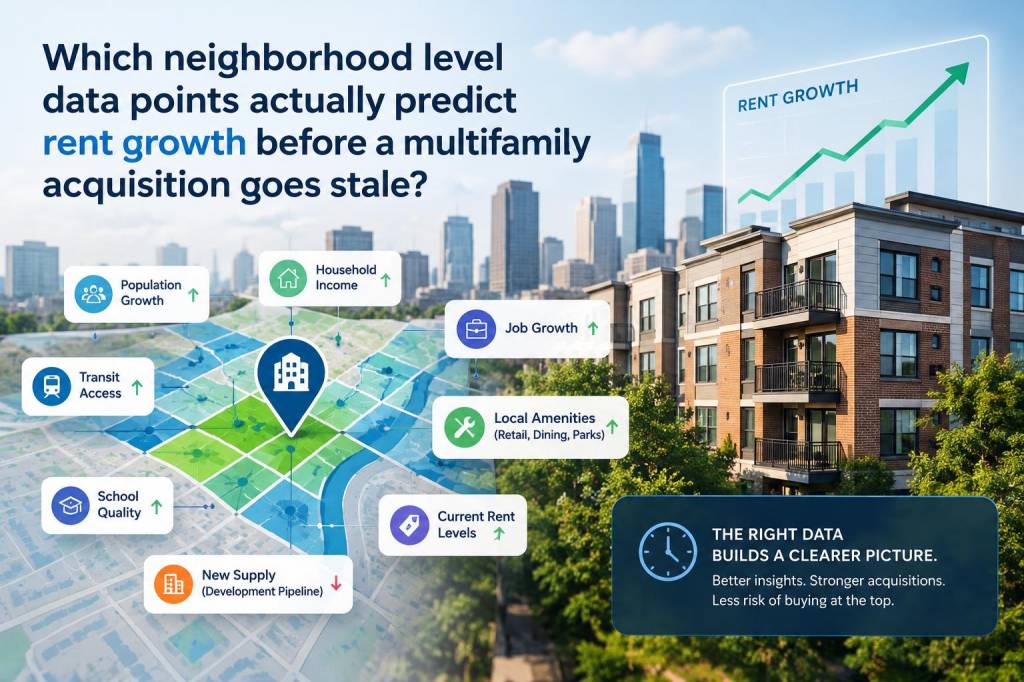
When I underwrite a multifamily acquisition, I care less about glossy marketing language and more about whether a neighborhood still has room to absorb rent growth before buyer excitement fades. A property can look attractive on paper, yet if the surrounding submarket is already cooling, the deal can age quickly. In my own analysis, I have found that neighborhood-level data often gives earlier signals than property-level metrics alone. Those signals do not guarantee future rent growth, but they can tell me whether I am buying into momentum or just chasing a story that is already priced in.
What matters most is not a single statistic. It is the pattern across several data points that, together, reveal whether demand is deepening, supply is tightening, and household behavior is shifting in a way that supports higher rents. I look for indicators that are local enough to matter and timely enough to warn me before the market becomes stale. In practice, that means I want to know who is moving in, who is moving out, what they can afford, how much new housing is arriving, and whether the neighborhood is becoming more attractive for renters with stable income.
Local income growth relative to asking rent
The first number I examine is income growth inside the immediate trade area, not just in the metro overall. A submarket can look strong at the city level while the neighborhood itself stagnates. If household income is rising faster than asking rent, renters usually have more capacity to absorb future increases. If rent is rising much faster than income, I become more cautious unless there is a clear reason why the neighborhood can keep stretching, such as a sharp improvement in access, safety, or employment concentration.
I like to compare current rent-to-income ratios with historic ranges for the same area. A neighborhood that is still below its long-term affordability ceiling often has more room to grow. Once that ratio moves too far above local norms, rent growth tends to slow, concessions increase, or turnover becomes more price-sensitive.
Migration patterns at the neighborhood edge
Neighborhood migration patterns often tell me more than citywide population growth. I want to know whether households are moving into the area from more expensive nearby markets, whether renters are staying longer, and whether the neighborhood is pulling in people who want a commute advantage or lifestyle upgrade. If the area is receiving steady inflows from higher-cost districts, that can support above-average rent growth because incoming residents often bring stronger budgets and different expectations.
I also watch for a subtle but important shift: whether people are moving out because they are being priced out, or because the neighborhood no longer matches what they want. The first can still support rent growth for a period, since replacement demand may remain strong. The second can be a warning sign that demand is softening even if occupancy still looks acceptable today.
- Net migration from adjacent high-cost neighborhoods
- Length of tenancy and turnover frequency
- Change in renter household size
- Share of new residents with stable employment profiles
Permit activity versus actual delivery
New construction is one of the clearest reasons a rent story can go stale. But I do not just look at permits in isolation. I compare permit activity with likely delivery timing, because a wave of approved projects can be less meaningful if financing delays push completions out. What I want to know is whether supply is actually arriving before my rent-growth thesis has time to play out.
If a neighborhood has rising permits, a visible pipeline, and faster lease-up competition, I become more selective. On the other hand, if permits are rising but land constraints, labor shortages, or capital tightening are slowing deliveries, the market may still have a temporary window for rent growth. In that case, timing becomes critical. I want to own before the pipeline hits, not after.
Rent dispersion within the neighborhood
One of the most useful signals I have found is rent dispersion, meaning the spread between lower-end and higher-end product inside the same neighborhood. If newer or renovated units are commanding a growing premium while older stock still leases reasonably well, that tells me demand is broad and upgrading tenants are willing to pay. That can support rent growth across the submarket, not just in one shiny asset class.
If, however, the premium keeps widening while the lower end weakens, I start asking whether the neighborhood is bifurcating. In that case, rent growth may be limited to a narrow slice of product, and a value-add thesis can become harder to execute. I want evidence that improvements are being rewarded by the market without leaving the rest of the rent stack behind.
| Data Point | What I Look For | What It Suggests |
|---|---|---|
| Income growth | Income rising faster than rent | More room for rent expansion |
| Net migration | Inflow from higher-cost nearby areas | Stronger tenant demand |
| Permit pipeline | Actual deliveries approaching soon | Possible future supply pressure |
| Rent dispersion | Healthy premium for upgraded units | Demand for improved product |
| Vacancy by sub-area | Tight vacancy near transit or jobs | Localized pricing power |
Vacancy patterns at micro scale
Vacancy matters far more when I can break it down by a few blocks, rather than looking at broad zip code averages. A neighborhood may show moderate vacancy overall, yet the portion closest to transit, schools, retail, or employment nodes can be much tighter. That is where rent growth often happens first. If vacancy is tightening in the most desirable pockets, it usually signals that renters are competing for convenience and quality.
I also pay attention to vacancy trends in competing buildings. If stabilized properties are holding occupancy with minimal concessions while newly delivered assets are struggling, the neighborhood may be absorbing supply faster than expected. If everyone is offering incentives at once, I assume demand is weaker than the headline occupancy numbers suggest.
Employment quality within commuting reach
Jobs still matter, but not all jobs support the same rent outcomes. I care about the quality of employment within commuting reach of the property. A neighborhood near hospitals, universities, logistics hubs, professional offices, or tech clusters often has more durable rental demand than one dependent on a single volatile employer. Even if the property is not directly adjacent to a major job center, I want evidence that the commute pattern supports a stable renter base.
I also look for job growth that is translating into renter demand, not just payroll growth on a map. If employment expands but the neighborhood does not attract the right household profile, rent growth may disappoint. The most valuable signal is when employment growth, household formation, and renter preference all point in the same direction.
Retail and amenity upgrades that change renter behavior
Rent growth is often tied to how people experience a neighborhood every day. A new grocery store, better café cluster, improved walkability, or visible public investment can shift renter perception faster than economic reports capture. I have seen neighborhoods reprice after a small number of highly visible improvements because renters interpret those changes as evidence that the area is on an upward path.
Still, I try not to overreact to hype. One trendy restaurant does not create sustainable rent growth. I want to see a pattern of amenity deepening: cleaner blocks, better daily-use retail, stronger street activity, and signs that residents are spending more time locally. Those features tend to support renewal at the unit level, especially when they coincide with income growth and tighter vacancy.
Tenant composition and credit signal
Another neighborhood-level data point I rely on is tenant composition. If the renter base is shifting toward households with stronger credit, longer employment tenure, or more predictable income streams, rent growth becomes more resilient. I am not trying to stereotype residents; I am trying to understand payment behavior and demand durability. A neighborhood that attracts stable households can usually support higher asking rents with less friction.
When I see a deterioration in tenant quality across the area, I become more conservative about underwriting future rent increases. That does not mean the deal is bad, but it may mean my rent assumptions need to be lower or my hold period shorter. I would rather miss a little upside than force a model that depends on fragile demand.
My practical screening framework
In my own process, I use neighborhood data as a filter before I get too attached to a deal. If several indicators align, I start believing the rent growth story. If they conflict, I slow down. My framework is simple enough to use quickly, but specific enough to avoid wishful thinking.
- Income growth must support the rent target
- Migration should favor the neighborhood, not drain it
- Supply delivery must be visible and timed correctly
- Vacancy should tighten in the strongest micro pockets
- Amenities must improve in ways renters actually use
- Tenant quality should remain stable or improve
What I have learned is that rent growth usually does not disappear overnight. It fades first in the data. You can often see the warning signs before they show up in a pro forma or a broker package. That is why I spend so much time on neighborhood-level indicators. They help me separate a living market from a stale one, and they keep me from paying today for growth that may already belong to yesterday.
When I feel confident in a multifamily acquisition, it is not because one chart looks strong. It is because the neighborhood tells a coherent story: households have room to pay more, supply has not yet overwhelmed demand, local amenities are improving, and the renter mix is supporting stronger pricing. If those pieces are in place, I know the asset has a much better chance of staying fresh rather than going stale right after closing.