When I look at a rental property refinance, I rarely start with the monthly payment. I start with capital efficiency. A shorter term can reduce interest expense, build equity faster, and improve long-run net worth. It can also quietly damage cash flow, weaken flexibility, and lower the property’s ability to absorb vacancies, repairs, or rent softness. That is why I treat a shorter-term refinance as a return decision, not just a debt decision.
For me, the central question is not whether a shorter term feels safer. It is whether the extra principal payment creates more value than using that same cash somewhere else. In rental real estate, cash flow, leverage, taxes, amortization, and exit timing all interact. A refinance that looks excellent on paper can still be a poor move if it squeezes operating margin too far.
What changes when I move from a longer term to a shorter term
A shorter term usually means a lower interest rate and much faster principal paydown. A 30-year loan refinanced into a 15-year or 20-year mortgage can save a large amount of interest over time. I often see this as attractive when a property is stable, rents are rising, and the owner has no near-term need for liquidity.
But the monthly payment usually rises. That higher payment changes the property’s risk profile. A property that once produced comfortable free cash flow may become tightly constrained. If one vacancy, one major repair, or one rent delay can push the property into negative cash flow, then the refinance may have traded long-term efficiency for short-term stress.
I think of it this way: the shorter term creates a forced savings plan. That can be powerful when I want to de-risk a mature asset. It can be counterproductive when I still need flexibility for growth, repairs, or portfolio rebalancing.
When I favor a shorter-term refinance
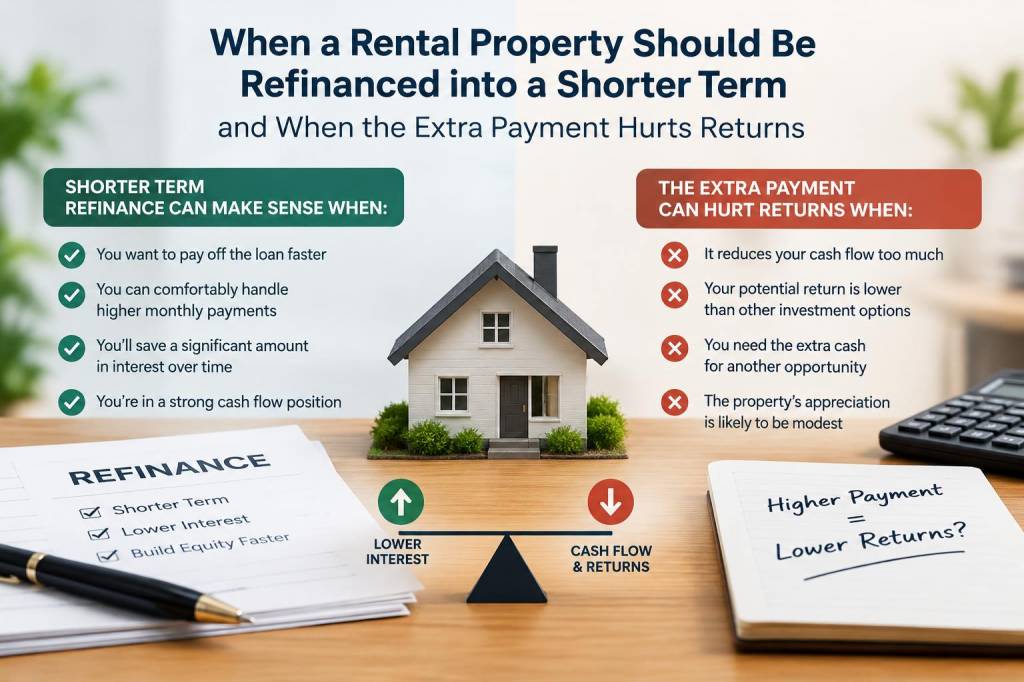
I usually prefer a shorter term when several of these conditions are present:
- The property has strong and stable cash flow after the new payment.
- Vacancy risk is low and operating expenses are predictable.
- The local market supports steady rent growth.
- I do not expect to sell soon, but I do want to reduce leverage.
- The refinance rate is meaningfully lower than the existing rate.
- I already have enough liquid reserves for repairs and vacancies.
In that kind of situation, the extra principal payment can make sense because the property is already performing well. The refinance reduces interest drag, accelerates equity accumulation, and can improve debt service coverage over time. If I am holding a property for many years, that compounding effect matters.
I also like shorter terms when I am nearing a lower-risk phase of ownership. For example, if a property has already appreciated, rents are strong, and I have no major capital projects ahead, I may be comfortable exchanging flexibility for efficiency. The property has earned that tighter structure.
When the extra payment hurts returns
The danger appears when owners confuse faster paydown with higher total return. They are not always the same thing. If the higher payment reduces cash flow so much that I cannot deploy capital into other opportunities, then the refinance may lower my overall portfolio return.
I am cautious when the property sits near break-even. A lower monthly cushion means that a bad month matters more. One roof replacement, one tenant turnover, or one temporary rent decline can erase the benefit of the lower interest rate. In those cases, the extra principal payment can be an expensive form of emotional comfort.
I am also cautious when I have better uses for capital. If I can earn a stronger return by funding another acquisition, improving a value-add unit, paying down higher-interest debt elsewhere, or keeping reserves for a likely opportunity, then forcing more money into one mortgage may not be rational. Real estate rewards patience, but it also rewards optionality.
Another issue is tax treatment. Interest on a rental mortgage is often deductible against rental income, while principal is not. That does not mean paying down debt is bad, but it does mean I must think in after-tax terms. A shorter term may reduce deductible interest expense faster, which can slightly change tax results. I never let the tax deduction drive the decision alone, but I never ignore it either.
The return comparison I use in practice
When I evaluate a refinance, I compare three things:
- The after-tax cost of the new debt.
- The cash flow I lose by accepting the higher payment.
- The return I can earn if I keep the cash and invest it elsewhere.
If the shorter-term refinance saves me interest, but the higher payment prevents me from building reserves or pursuing a stronger opportunity, the true return may be weaker than it first appears. I want to see whether the new debt structure improves portfolio-level performance, not just loan-level performance.
Here is a simple mental framework I use. Suppose the shorter-term refinance reduces interest expense, but also lowers monthly free cash flow by a meaningful amount. If that lost cash flow would otherwise fund another property’s down payment, a renovation, or a reserve account that protects me from forced sales, then the opportunity cost may outweigh the savings.
| Factor | Shorter Term Helps | Shorter Term Hurts |
|---|---|---|
| Monthly cash flow | Still strong after payment increase | Becomes tight or negative |
| Liquidity | Strong reserves already in place | Cash needed for repairs or vacancies |
| Return on capital | Few better uses for capital | Other opportunities offer higher returns |
| Risk profile | Property is stable and seasoned | Property is still vulnerable to surprises |
| Time horizon | Long hold planned | Possible sale or recapitalization soon |
Why I care about debt service coverage
Debt service coverage ratio, or DSCR, is one of the first numbers I look at. If net operating income falls too close to the mortgage payment, I lose room to breathe. A shorter-term loan can be excellent when the property still has a strong DSCR after refinance. It becomes dangerous when the ratio tightens so much that the margin for error nearly disappears.
I want enough cushion that the asset can handle normal friction. Rental properties are rarely smooth. Tenants leave, repairs arrive unexpectedly, and leasing cycles never move in a straight line. A refinance that looks mathematically neat but leaves almost no breathing room can force me into bad decisions later.
That is especially true in markets with softer rent growth or higher operating volatility. In those places, I prefer to keep more cash flow rather than accelerate principal at all costs.
Signs that I should probably keep the longer term
I usually keep the longer term when I see one or more of these warning signs:
- The property depends on near-perfect occupancy to stay cash flow positive.
- I expect major capital spending within the next few years.
- My reserve account is thin.
- I may want to refinance, sell, or exchange the property soon.
- Comparable investments offer stronger expected returns.
- The rate reduction is too small to justify the loss of flexibility.
In those cases, I would rather preserve optionality. A longer term can act like insurance. It may not maximize equity buildup, but it can protect the operating business inside the property.
When I see a shorter term as a strategic reset
There are moments when I think a shorter-term refinance can reset the whole investment. I especially like it after a property has been stabilized, improved, and seasoned. If I have already completed the renovation, signed reliable tenants, and built a stronger income stream, then moving to a shorter term can lock in quality and reduce long-run financing drag.
I also like it when the property is one piece of a broader plan to become more conservative. If I have too much leverage across the portfolio, shortening one or two loans can improve resilience. In that case, I am not simply chasing returns; I am reshaping risk.
Another scenario is when the owner has no higher-value use for excess cash and prefers a disciplined way to build equity. Some investors are not trying to maximize current income. They want a faster path to outright ownership. If that matches the goal, a shorter term can be very effective.
The question I ask before I sign anything
Before I approve a shorter-term refinance, I ask a very direct question: What does this loan structure let me do that I could not do otherwise? If the answer is only that I will own the property sooner, I still need to test whether that future equity is worth the present sacrifice. If the answer is that I reduce risk, improve long-term value, and still keep enough cash flow to stay flexible, then the refinance starts to look compelling.
I do not want a mortgage that makes me feel disciplined while quietly weakening the business. I want a structure that supports both growth and stability. Sometimes that means moving to a shorter term. Sometimes it means leaving the current loan in place and letting cash flow do its work.
In practice, I tend to favor the shorter term when the property is already strong, reserves are healthy, and the cash flow cushion remains comfortable after the refinance. I tend to avoid it when the property is still delicate, when better opportunities exist for capital, or when the higher payment would make me less agile in a market that can change quickly.